
Built for Operationally Mature Organizations
Operational Maturity Is the
New Competitive Advantage
Companies managing multiple projects, larger sales teams, and increasing transaction complexity need operational visibility, consistency, and structure that can scale alongside the business.
Operational Debt is a choice to trade future scalability for present speed
Most real estate development sales operations were never intentionally architected, they became reactive and patched together over time.
Growth Exposes Operational Debt
Small teams can survive chaos. Large teams cannot.
Often smaller teams build an accidental system that “works” until scale exposes its inherent fragility. This is particularly dangerous for growing developers, multi-project operators, and scaling sales teams.
- At 5 deals, memory, email, sticky notes, and spreadsheets, and informal communication keeps things moving.
- At 50 deals, information starts becoming fragmented across systems, departments, and people, making coordination significantly harder.
At 500 deals, operational fragmentation turns into a serious business risk that impacts visibility, efficiency, and scalability.

The 4 Stages of Operational Debt
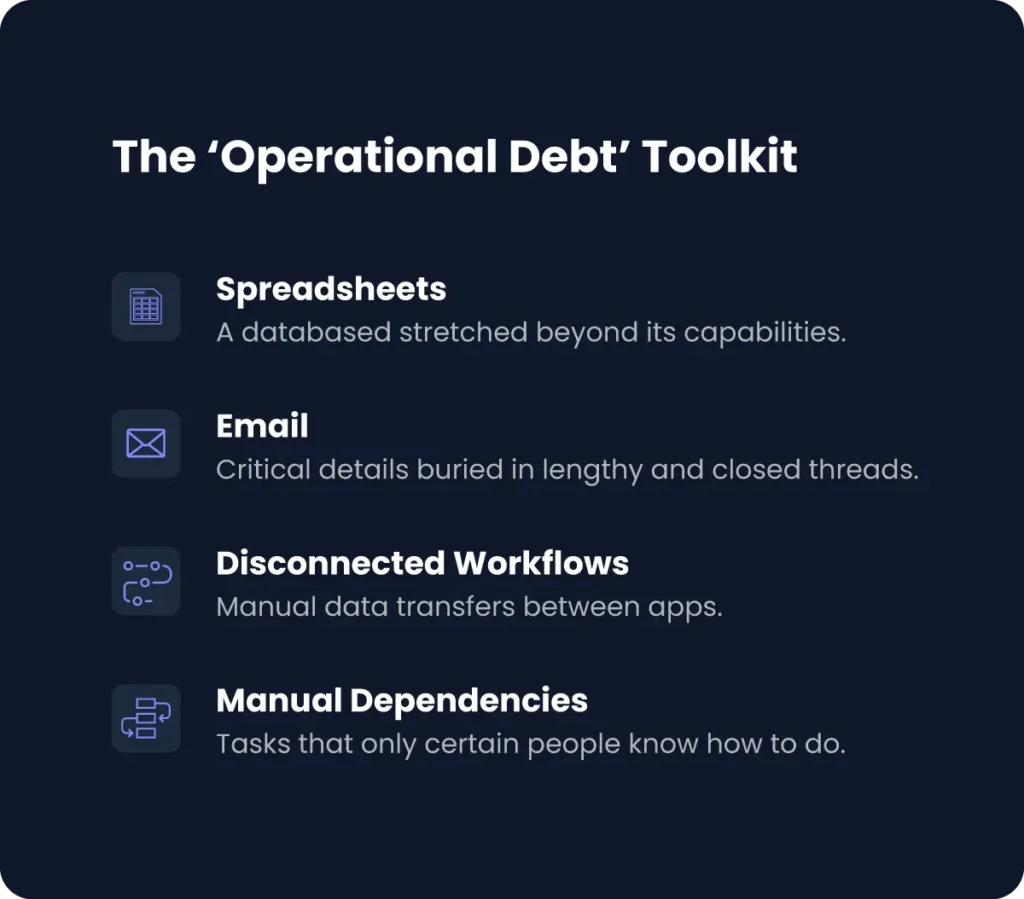
Operational Debt happens when a business grows beyond what its systems and processes were originally designed to support. Instead of investing in the right tools, they make do with existing software, creating temporary patches to bridge functional gaps.
The Workaround
At this stage:
- Companies are moving fast, figuring things out as they go, and solving problems in the moment
- Processes are lightweight, communication is informal
- Most work depends on individuals stepping in wherever needed
It works early on because the business is still small enough for people to keep everything in their heads.

The Process
At this stage:
- The company begins turning repeated actions into repeatable process
- Teams document workflows, create handoff systems, and establish routines that bring consistency to the business
What once felt temporary becomes embedded into day-to-day operations and starts shaping how the company runs
The Fragility
At this stage:
- Complexity begins outpacing the systems that were built to manage it
- Different teams create their own workflows, information becomes fragmented, and visibility starts breaking down across the organization
The business may still appear operationally functional from the outside, but internally, coordination becomes increasingly difficult and fragile.
The Scalability Wall
At this stage:
- The organization reaches the point where growth creates more operational strain than operational leverage
- Teams spend more time coordinating work than executing it
- The business becomes dependent on institutional knowledge, manual oversight, and constant follow-up
Without a unified operational system, scale becomes difficult to sustain.
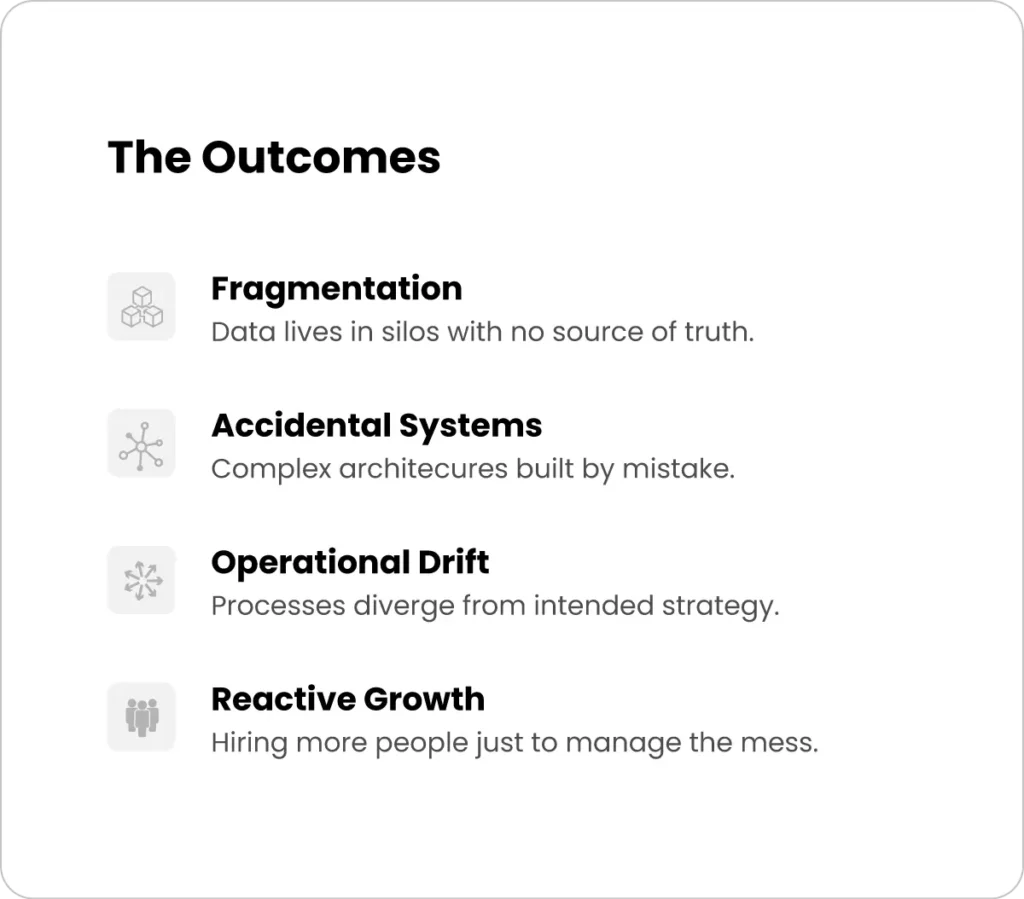
Eventually, the system is held together by experience, memory, and manual coordination. The infrastructure is no longer software, it’s the people struggling to keep it alive.
Why Most Companies End Up Here
Most Real Estate Operations Weren’t Designed, They Evolved
Most teams did not intentionally choose fragmented operations, workflows evolved gradually over years.
At each stage, the workaround likely made sense. But, what worked at 20 deals often breaks at 200.
Temporary operational fixes tend to become permanent infrastructure if they are not intentionally redesigned later.

Pluto Transforms Accidental Workflows into Intentional Operational Systems
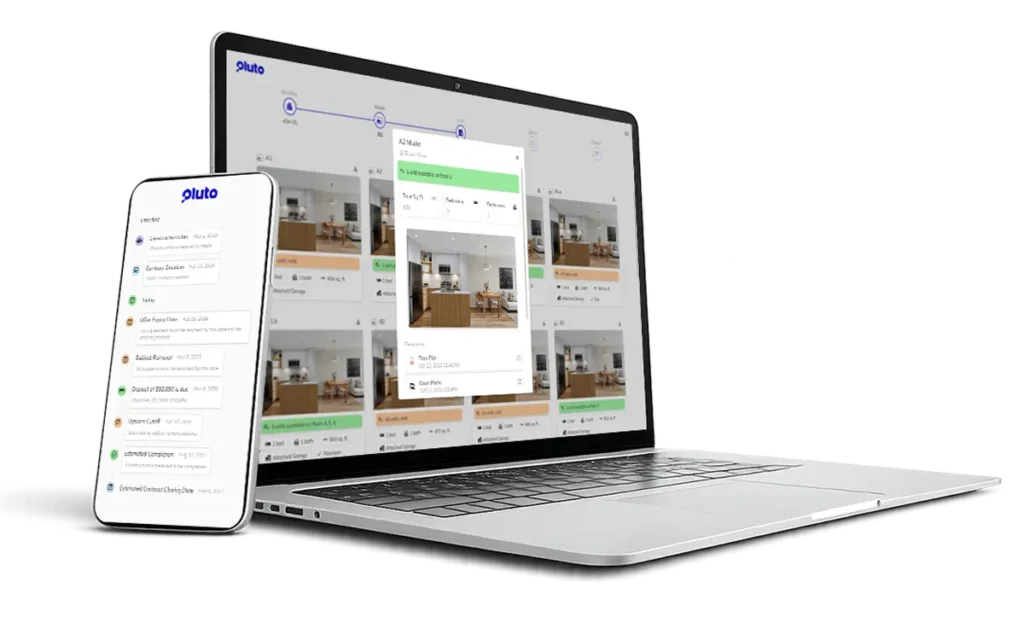
The goal is not simply to replace spreadsheets or digitize paperwork, it’s to transform fragmented, reactive workflows into a centralized operational system built for scale.
Contract Management
Effortlessly manage, edit, sign, and distribute contracts while ensuring seamless FINTRAC compliance.
Client Management
Centralize communication and engagement with all stakeholders, including purchasers, realtors, and internal teams.
Inventory Management
Gain real-time visibility into your inventory and sales progress.
Reporting & Analytics
Real-time reporting across all your active projects without exports, spreadsheets, or manual work.
Customer Connect
Structure deals in minutes, not hours, while the buyer is still engaged.
Client Portal
Empower potential buyers and realtors with self-service tools to explore, register, and reserve properties.
Service*
End-to-end timeline and resolution tracking.
*Coming soon
Move-in Management*
Audit-ready walkthroughs and CIC support.
*Coming soon
You Don’t Need More Tools,
You Need a Better System
Pluto is built for the moment a buyer decides to move forward.
- Structure deals in minutes
- Work from a single, unified system
- See the real-time status of every deal
- Trust the accuracy of every deal with structured workflows
- Create a seamless and professional buying experience
- Manage changes cleanly without long email threads or scattered updates
From the Blog


FAQ
Pluto Systems is purpose-built for new residential development sales. Our platform is designed specifically for production builders and real estate developers managing single-family, townhome, and multi-family inventory, particularly teams selling 30+ homes per year with internal sales operations.
Pluto excels in environments where:
- Multiple units are sold simultaneously
- Contracts require amendments and version control
- Deposits and payment schedules must be tracked
- Sales and construction teams need synchronized visibility
- Buyer upgrades and change orders must flow cleanly into operations
While some commercial projects may share similar workflows, Pluto is optimized for the complexity and volume of residential development sales, not office leasing, retail tenant management, or custom one-off commercial builds.
If you’re managing pre-construction residential inventory across multiple projects and teams, Pluto was built for you.
Pluto supports FINTRAC compliance by guiding purchasers through ID verification and declaration forms as part of the online registration process. This helps ensure that key compliance steps are addressed early, before contracts are created.
The system reduces the need for paperwork and helps sales teams stay focused on communication and closing. Compliance tasks are handled within the platform in a secure and organized way, giving your team confidence that the process is complete and properly documented.
While most CRM platforms were built to manage relationships and marketing pipelines, Pluto was built to manage live, high-value contracts in real estate development.
An easy way to think about it is, a CRM tracks people, whereas Pluto tracks commitments.
Traditional CRMs are excellent at lead capture, email campaigns, pipeline forecasting, but once a contract is signed, most teams fall back into spreadsheets, email threads, shared drives, and manual checklists.
That’s where risk begins.
Pluto is purpose-built for developers and builders managing live inventory, contracts, deposits, amendments, upgrades, and internal coordination between sales and construction.
We focus on:
- Contract lifecycle management
- Real-time inventory control
- Payment scheduling & tracking
- Audit trails & compliance visibility
- Cross-team coordination
Pluto operationalizes the entire sales workflow. So for teams managing dozens, or even hundreds, of live contracts, that makes a big difference with visibility, efficiency, compliance, and coordination.
Implementation timelines depend on the size of your team and the complexity of your current workflow, but most Pluto clients are fully operational within 4–8 weeks.
Since Pluto is purpose-built for residential development sales, we are not forcing you to reinvent your process, we are structuring and digitizing what you already do.
A typical rollout looks like this:
Week 1–2: Discovery & Workflow Mapping
We map your current contract lifecycle, payment schedules, approvals, and reporting structure.
Week 2–4: Configuration & Data Migration
We migrate active projects, inventory, contracts, and relevant buyer data from spreadsheets, shared drives, or existing CRMs.
Week 4–6: Training & Parallel Run
Your team runs Pluto alongside your current system to ensure accuracy and comfort before going fully live.
Go-Live:
Once your team is confident, Pluto becomes your system of record for live contracts.
Most teams are surprised by how quickly the transition happens, especially compared to traditional ERP implementations.
Our goal is simple: Move you from spreadsheet and email-based deal management to structured, real-time visibility, without disrupting active sales.
Pluto Systems is built for mid-to-large residential developers and production builders who manage high volumes of live contracts across multiple projects.
We are best suited for teams that:
- Sell 30+ homes per year
- Manage pre-construction or production inventory
- Have an internal sales team
- Rely on spreadsheets, email, shared drives, or disconnected CRM tools
- Want better visibility across contracts, deposits, amendments, and upgrades
- Need tighter coordination between sales and construction
Pluto is especially valuable for organizations that are growing, where deal volume has increased, complexity has multiplied, and existing systems are starting to break.
We are not designed for:
- Custom one-off home builders
- Small teams managing only a handful of deals per year
- Purely commercial leasing operations
Pluto is purpose-built for structured residential development sales, where operational maturity, audit trails, and real-time visibility matter.
If your team has ever said, “We’re managing too many live contracts to keep doing this in spreadsheets,” you’re likely a strong fit.
NOW ACCEPTING SPRING 2026 PROJECTS
Discover a better way to manage new home sales
Book a demo to see how Pluto works and explore how we can support your new home sales operations.