How to Build a Real Estate Sales Operation That Scales
Operational Chaos Has Become Normalized
Spreadsheets, email threads, shared drives, sticky notes, and disconnected systems often become the infrastructure teams depend on to manage high-value deals.
When the business is small, experienced people can usually hold everything together through effort, memory, and constant communication.
But growth changes the equation. More projects create more dependencies, more communication, more complexity, and more risk.
Slower Deal Cycles
Reporting Delays
Buyer Frustration
Employee Burnout
Admin Mistakes
Version Conflicts
The 5 Fundamentals of Scale
Organizations with centralized visibility, connected workflows, and structured data will gain disproportionate advantages over time.

Create a Single Source of Truth
The fastest way to create operational confusion is allowing critical information to exist across multiple disconnected systems. When deals are tracked through spreadsheets, email threads, PDFs, Slack messages, and shared drives simultaneously, teams lose confidence in what information is accurate.
Scaling organizations centralize operational information so teams always know where information lives, what changed, who updated it, and which version is correct.
WHAT THIS REMOVES
Confusion, duplicated work, version uncertainty, and operational hesitation.

Standarized Workflows
Standardization creates predictability, which is critical for scalability. When different employees handle the same workflow differently, inconsistency compounds quickly as volume increases.
Mature organizations standardize deal stages, approvals, communication workflows, document handling, reporting structures, and operational processes.
WHAT THIS IMPROVES
Communication, approvals, onboarding, reporting reliability, operational visibility, and error prevention.

Reduce Reliance on Human Memory
Many organizations are unknowingly operating on memory-based infrastructure. People remember follow-ups, deadlines, buyer details, and next steps. That may work temporarily, but memory does not scale reliably.
Strong systems move operational dependencies into structured workflows. Follow-ups become tasks. Deal stages become visible. Approvals become standardized. Communication histories and milestones become centralized.
THE GOAL
Make workflows visible, trackable, and repeatable so employees no longer carry operational complexity mentally all day long.

Build Visibility Across Departments
As organizations grow, silos become increasingly dangerous. Disconnected departments create disconnected decisions.
Operationally mature organizations connect workflows across sales, operations, finance, construction, and customer care so information entered by one team becomes visible and usable throughout the broader operational lifecycle.
EXAMPLES
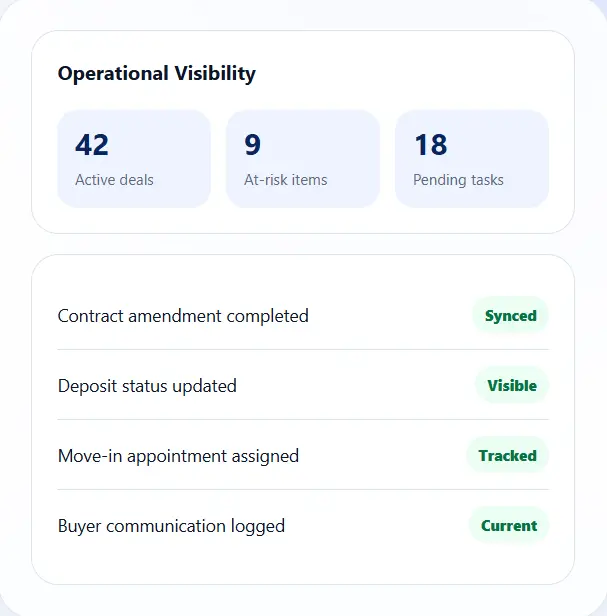
A sales amendment should be visible to operations immediately. Upgrade selections should flow into construction workflows. Buyer communication history should be accessible to customer care. Deposit status should be visible to finance and operations at the same time.

Make Reporting a Byproduct of Operations
If reporting requires hours of manual effort every week, the underlying operational infrastructure is fragmented. Leadership should not need to chase information across multiple departments just to understand sales performance, project risk, workflow delays, or where operational friction is developing.
Connected systems make reporting more immediate, more consistent, and more useful because the data is created through day-to-day operations rather than reconstructed after the fact.
THE SHIFT
From lagging reports assembled manually to live operational data leadership can trust.
Pluto Systems
A Centralized Operational System
Built For Scale
Contract Management
Effortlessly manage, edit, sign, and distribute contracts while ensuring seamless FINTRAC compliance.
Client Management
Centralize communication and engagement with all stakeholders, including purchasers, realtors, and internal teams.
Inventory Management
Gain real-time visibility into your inventory and sales progress.
Reporting & Analytics
Real-time reporting across all your active projects without exports, spreadsheets, or manual work.
Customer Connect
Structure deals in minutes, not hours, while the buyer is still engaged.
Client Portal
Empower potential buyers and realtors with self-service tools to explore, register, and reserve properties.
Customer Service*
End-to-end timeline and resolution tracking.
*Coming soon
Move-in Management*
Audit-ready walkthroughs and CIC support.
*Coming soon
The Next Generation of Real Estate Leaders Will Operate with Greater Intelligence
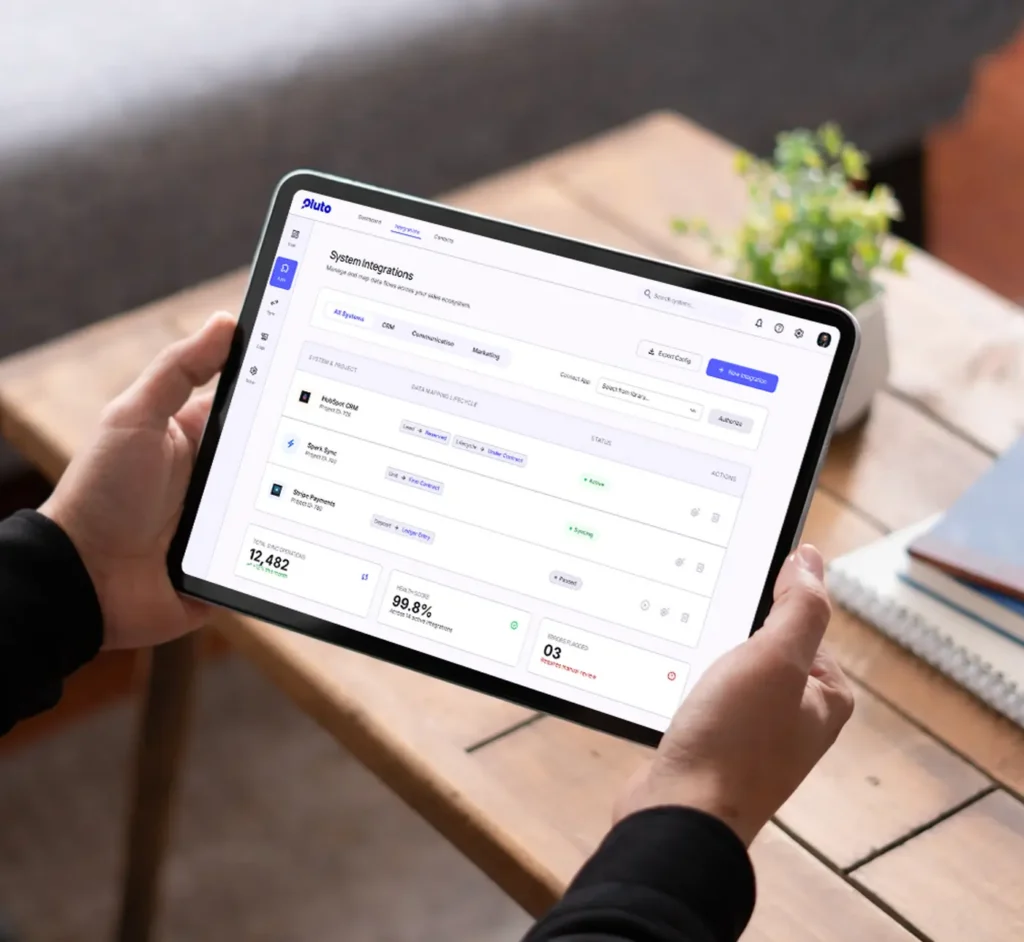
Since Pluto’s apps operate from a unified data model, information flows more seamlessly between sales, operations, finance, customer care, reporting, and construction-related workflows.
Instead of departments operating independently with fragmented visibility, teams work from connected operational data that creates greater alignment across the entire purchaser lifecycle.